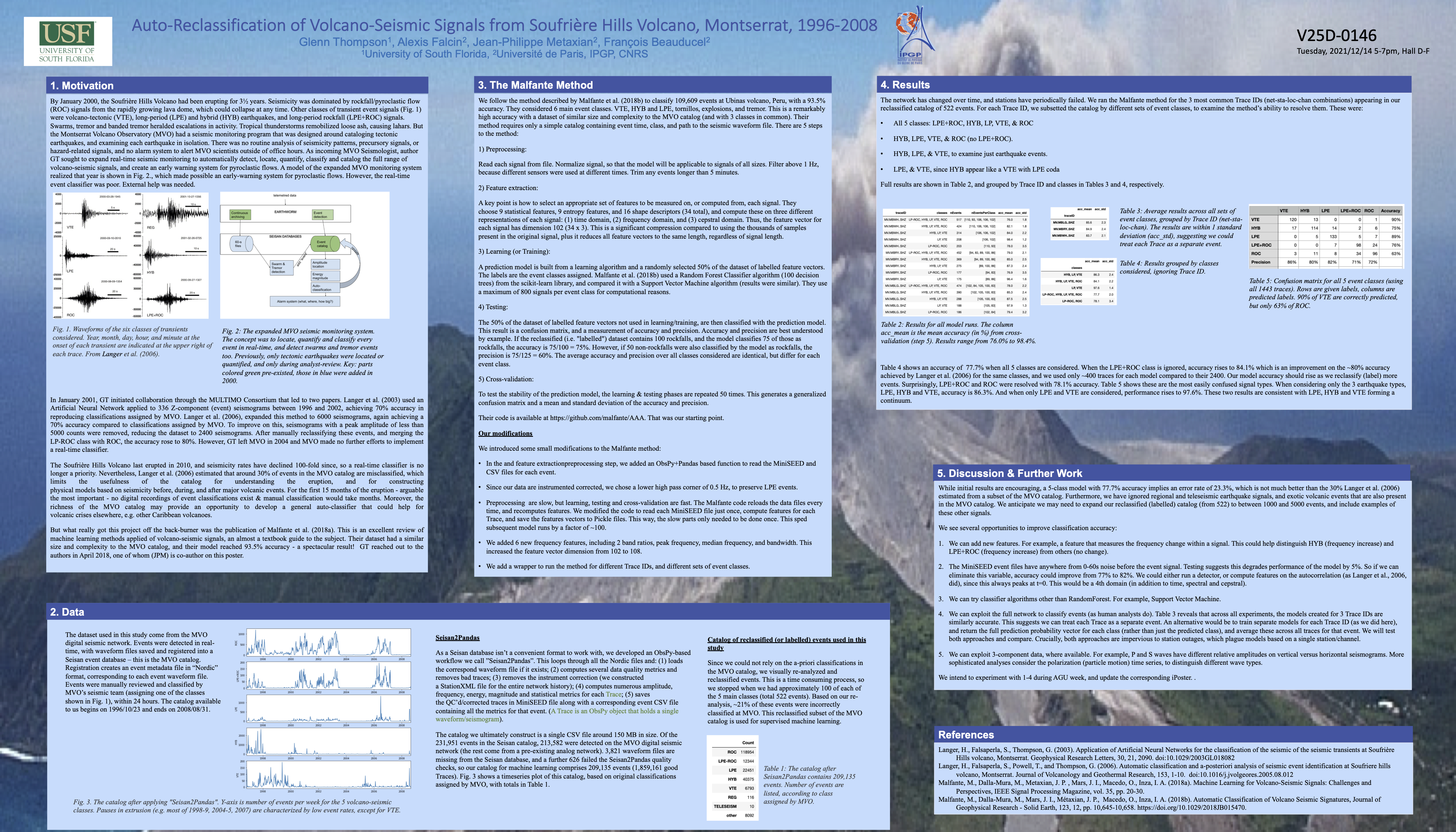
When the proportion of hybrid earthquakes in a volcano catalog changes, has the volcano changed, or have analysts drawn the boundary between event types differently? At Soufrière Hills Volcano, many analysts classified earthquakes and rockfalls over the course of the eruption. Their catalog gave us a way to investigate that question.
Revisiting the observatory catalog
The original project proposed using artificial neural networks to reclassify records from the Montserrat Volcano Observatory (MVO). Earlier collaborations tested neural networks on selected waveforms. In the study presented at AGU in 2021, we revisited the digital archive with a random forest classifier. We reviewed and labeled 522 events and tested how well the model reproduced those labels using waveform measurements from three frequently recorded channels.
Which signals could the classifier distinguish?
The five classes were volcano-tectonic earthquakes, hybrid earthquakes, long-period earthquakes, rockfalls, and long-period signals associated with rockfalls. Mean accuracy in the five-class tests was 77.7%. When the task was narrowed to distinguishing long-period from volcano-tectonic earthquakes, mean accuracy reached 97.6%. Those percentages describe different classification tasks on the reviewed sample. Distinguishing two earthquake types was considerably easier than sorting the full mixture of earthquake and rockfall signals.
AGU 2021 poster
Auto-Reclassification of Volcano-Seismic Signals from Soufrière Hills Volcano, Montserrat, 1996–2008
Glenn Thompson, Alexis Falcin, Jean-Philippe Metaxian, and François Beauducel · Poster V25D-0146